Every week, someone sits across from me at the clinic and asks the same question before their first GFC session: “Doctor, are there any side effects?”
It is a fair question. Growth Factor Concentrate therapy has gained real traction in India over the last two years, and patients are right to want the full picture before they go ahead with any injection-based treatment.
The honest answer is that GFC hair treatment has a strong safety record. Because the treatment uses your own blood, the risk of a serious reaction is quite low. That said, no procedure is completely free of side effects, and I believe every patient deserves to know exactly what to expect, what is normal, and what would warrant a call to the clinic.
This guide covers all of it.
What is GFC hair treatment?
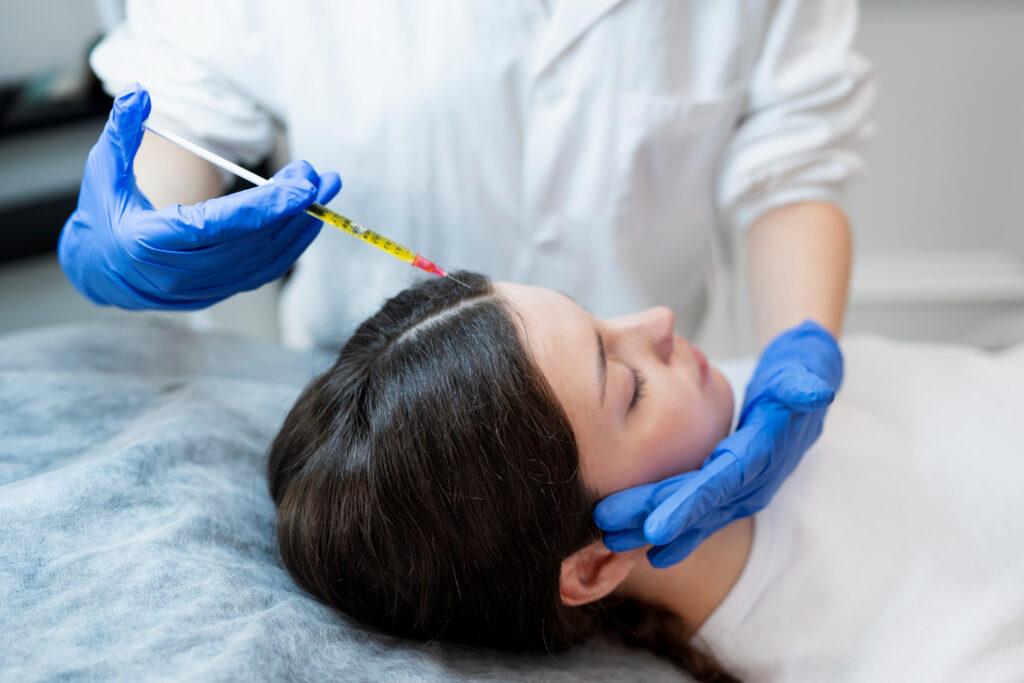
GFC stands for Growth Factor Concentrate. The treatment works by drawing a small sample of your own blood, processing it to extract a concentrated solution of growth factors (proteins that signal your hair follicles to repair and regenerate), and injecting that solution into the scalp.
Unlike PRP (Platelet Rich Plasma), GFC does not require an external activation agent like calcium chloride. The processing step produces a purer, more concentrated preparation of growth factors, which is one reason its safety profile tends to be slightly better.
The autologous nature of GFC (meaning it comes entirely from your own body) is the single biggest reason serious side effects are rare. Your body is not being asked to tolerate a foreign substance.
Is GFC hair treatment safe?
| Short answer: Yes, GFC is among the safer options for hair loss treatment. Because it uses your own blood-derived growth factors, the risk of an allergic or systemic reaction is very low. The side effects that do occur are almost always mild and short-lived. |
That said, the word “safe” can give people the wrong idea. Every patient responds a little differently, and there are specific groups who should avoid this treatment altogether (more on that below).
The side effects of GFC hair treatment fall into two categories: common ones that most patients will experience to some degree, and rare ones that most patients will never encounter.
Common side effects of GFC treatment
These are the side effects you should expect. They are a normal part of the body’s response to any injection and are not a sign that something has gone wrong.
| Side Effect | Severity | Duration | What to do |
| Mild scalp redness | Low | 24 to 48 hours | Normal; no action needed |
| Swelling at injection site | Low | 1 to 2 days | Cold compress if uncomfortable |
| Soreness or tenderness | Low | 2 to 3 days | Paracetamol if needed |
| Pinpoint bleeding | Minimal | Same day | Resolves on its own |
| Mild itching | Low | 24 hours | Avoid scratching; keep area clean |
Why these happen
When growth factors are injected into the scalp, the body responds by increasing blood flow to the area. This localised inflammatory response is actually part of the healing process. The redness, mild swelling, and tenderness you feel in the first day or two are your scalp responding to the treatment, not fighting it.
Pinpoint bleeding at injection sites is completely expected. The needles used for GFC injections are fine gauge, and the small dots of blood at each injection point typically resolve within minutes.
Rare side effects
These occur infrequently, but I want to be transparent about them.
Infection at the injection site
This is extremely rare when the procedure is done in a proper clinical setting. The risk increases if the treatment is performed in an unsterile environment. If you notice pus, increasing warmth, or worsening pain after 72 hours, contact your doctor.
Temporary hair shedding
Some patients experience a shedding phase roughly four to six weeks after their first session. This can be alarming if you are not expecting it. What is happening is that the growth factors are pushing weak, resting hair follicles into an active cycle. The old hairs shed to make room for the new growth. It is a sign the treatment is working, though this is not guaranteed for every patient.
Uneven initial results
Hair follicles do not all respond at the same rate. Some patients notice patchy regrowth in the early months before the results even out. This is normal and generally self-corrects by month four or five.
Poor or no response
GFC therapy is most effective for early to moderate hair loss. Patients with advanced hair loss, particularly Norwood Grade V or higher, may see limited benefit. It is important to have realistic expectations going in.
Who should not get GFC treatment?
Contraindications are where I spend considerable time during consultations. GFC may not be appropriate for you if any of the following apply:
- Active scalp infection or scalp psoriasis: injecting into an inflamed scalp can worsen the condition
- Bleeding or clotting disorders: the procedure involves multiple scalp injections and requires normal clotting function
- Patients on blood-thinning medications (anticoagulants): you may need to pause these before treatment, only under your physician’s supervision
- Pregnancy and lactation: the effects of GFC on foetal development are not established, so we do not recommend it during this period
- Active autoimmune conditions: the immune dysregulation involved can interfere with the treatment’s mechanism
- Very advanced hair loss (Norwood V and above): there is insufficient follicular density to support meaningful regrowth
If you fall into any of these groups, a thorough consultation with a qualified dermatologist is essential before you make a decision.
How GFC compares with PRP on safety
I am often asked whether GFC or PRP is safer. The differences are real but modest.
| Factor | GFC | PRP |
| Allergic reaction risk | Very low (autologous) | Low to moderate (activators used) |
| Post-procedure swelling | Mild, 1 to 2 days | Mild, 2 to 3 days |
| Injection site pain | Mild | Mild to moderate |
| Downtime | Minimal (same day) | Minimal (same day) |
| Shedding phase | Possible (weeks 4 to 6) | Possible (weeks 3 to 6) |
| Number of sessions | Typically 3 sessions | Typically 4 to 6 sessions |
PRP uses platelets activated by an external agent, which introduces a small additional variable. GFC’s processing method produces a platelet-free, growth-factor-rich preparation, which typically means slightly less post-procedure inflammation. In practice, both treatments have similar downtime and neither requires you to take time off work.
For patients with sensitive skin or a history of minor reactions to injection procedures, the GFC protocol may be a more comfortable option.
How to manage side effects after GFC treatment
Post-care is straightforward. Following these instructions reduces your risk of complications and helps the growth factors work as intended.
For the first 24 hours:
- Do not wash your hair
- Avoid rubbing or touching the scalp
- Skip strenuous exercise, sweating can introduce bacteria to the injection sites
- Stay out of direct sun, especially between 10 AM and 4 PM
For the first 48 to 72 hours:
- No heat styling tools (blow dryers, flat irons, curlers)
- Avoid swimming pools, especially chlorinated ones
- Drink plenty of water, hydration helps growth factor absorption
What to expect week by week
This is roughly what the post-treatment timeline looks like for most patients:
| Timeframe | What to expect |
| Days 1 to 3 | Mild redness and tenderness at injection sites. This is normal and does not need treatment unless it is worsening. |
| Week 1 to 2 | Side effects subside. The scalp should feel normal again. |
| Week 4 to 6 | Some patients notice a shedding phase. This is not hair loss, it is the natural turnover triggered by follicle activation. |
| Month 3 to 4 | New hair growth starts to become visible. Texture and density improvements begin. |
| Month 5 to 6 | Full assessment of results. Most patients require a repeat session at this point for sustained benefit. |
Frequently asked questions
Does GFC hair treatment hurt?
There is mild discomfort during the injections, similar to what you would feel with any scalp procedure involving fine needles. Most patients tolerate it well without any anaesthesia, though we apply a topical numbing cream before the session if you prefer.
How long do GFC side effects last?
Most side effects like redness, minor swelling, tenderness clear within 48 to 72 hours. The shedding phase, if it occurs, can last four to eight weeks before new growth becomes visible.
Can GFC cause permanent hair loss?
No. There is no evidence that GFC causes permanent hair loss. Any shedding that occurs post-treatment is a temporary, expected part of the follicle activation cycle.
Is GFC safe for all hair types and skin types?
GFC works on most hair types. Scalp skin type is less relevant since the treatment targets the hair follicle beneath the surface. The key factor is the stage of hair loss, not hair or skin type.
How many GFC sessions will I need?
A standard protocol involves three sessions spaced four to six weeks apart. Maintenance sessions are recommended every six to twelve months depending on your response.
What is the downtime after a GFC session?
There is essentially no downtime. Most patients return to work the same day. You should avoid strenuous exercise and sun exposure for 24 hours, but beyond that, daily activities can resume normally.
Can I wash my hair after GFC treatment?
Wait at least 24 hours before washing your hair. After that, use a mild, sulphate-free shampoo for the first week to avoid irritating the injection sites.
When to call your doctor
The following symptoms are not typical and should be reported to your treating doctor promptly:
Contact your doctor if you notice:
- Fever or flu-like symptoms within 48 hours of treatment
- Pus or discharge from any injection site
- Pain that worsens beyond 72 hours rather than improving
- Significant hair shedding that continues beyond eight weeks
- Blistering or skin breakdown on the scalp
These are rare, but when they occur, they are almost always treatable with prompt attention. Never dismiss worsening symptoms as “just a reaction.”