When it comes to advanced laser treatments for skin rejuvenation, two technologies stand out: CO2 lasers and Pico lasers. Both are powerful tools in aesthetic dermatology, but they work differently and are suited for different skin concerns. At Dr. Kshitij Saxena’s Skin Clinic in Lucknow, we offer both treatments, and understanding the difference can help you make an informed decision about which is right for you.
Understanding the Basics
What is CO2 Laser Treatment?
CO2 (Carbon Dioxide) laser is an ablative laser treatment that has been the gold standard for skin resurfacing for decades. It works by removing thin layers of skin with precision, stimulating collagen production and revealing fresher, younger-looking skin underneath. The CO2 laser is particularly effective for deeper skin concerns and offers dramatic results.
What is Pico Laser Treatment?
Pico laser, also known as picosecond laser, is a newer technology that delivers ultra-short pulses of energy to the skin in trillionths of a second. Unlike ablative lasers, Pico laser is generally non-ablative or minimally ablative, meaning it doesn’t remove layers of skin. Instead, it works by creating microscopic channels in the skin and breaking down pigmentation particles into tiny fragments that the body can naturally eliminate.
How They Work: The Key Difference
The fundamental difference lies in their mechanism of action:
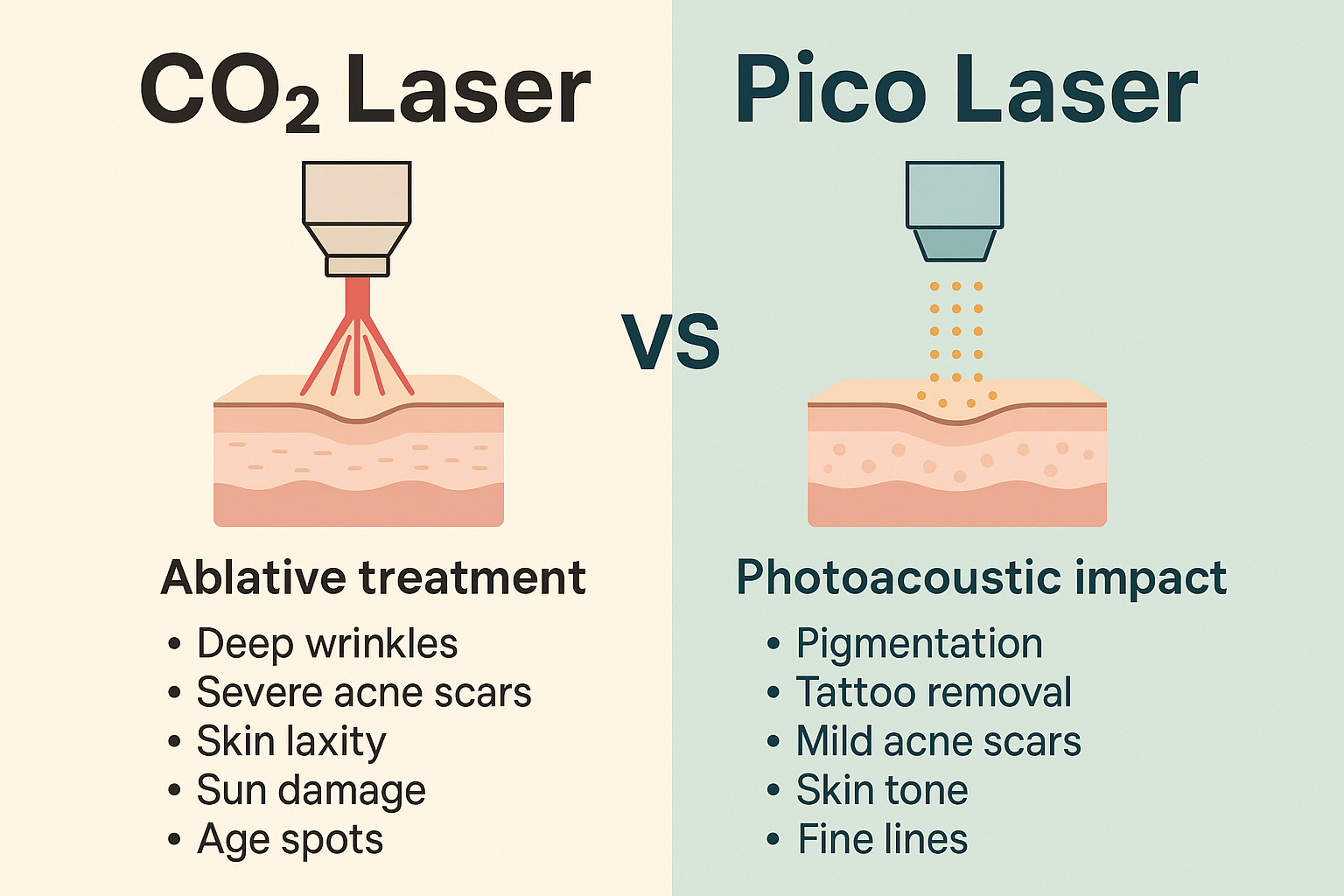
CO2 Laser uses heat to vaporize skin tissue layer by layer. This controlled damage triggers the body’s natural healing response, promoting collagen remodeling and skin tightening. It’s an ablative treatment, meaning it removes the outer layers of skin.
Pico Laser uses photoacoustic impact rather than heat. The ultra-short pulses create a pressure wave that shatters pigment and stimulates collagen without significantly damaging surrounding tissue. This makes it gentler with less downtime.
Best Uses for CO2 Laser
CO2 laser excels at treating:
- Deep Wrinkles and Fine Lines: Particularly effective for crow’s feet, forehead lines, and around the mouth
- Severe Acne Scars: Can significantly improve the appearance of deep, pitted scars
- Skin Laxity: Tightens loose skin on the face and neck
- Sun Damage: Removes severely sun-damaged skin layers
- Age Spots and Large Pigmented Lesions: Effective for larger, darker spots
- Warts and Skin Tags: Can precisely remove unwanted growths
- Surgical Scars: Helps flatten and fade raised or depressed scars
Best Uses for Pico Laser
Pico laser is ideal for:
- Pigmentation Issues: Melasma, sunspots, freckles, and post-inflammatory hyperpigmentation
- Tattoo Removal: More effective than traditional lasers, especially for stubborn colors
- Mild to Moderate Acne Scars: Improves texture without significant downtime
- Skin Tone and Texture: Provides overall skin rejuvenation and brightening
- Fine Lines: Addresses superficial aging concerns
- Pore Size Reduction: Helps minimize the appearance of enlarged pores
- Dull Skin: Revitalizes tired, lackluster complexions
Downtime and Recovery
CO2 Laser Recovery
CO2 laser requires more significant downtime due to its ablative nature. Patients can expect:
- Redness and swelling for 7-14 days
- Peeling and crusting as the skin heals
- Full healing typically takes 2-3 weeks
- Sun protection is crucial for several months
- Social downtime of about 1-2 weeks
- Multiple sessions may not be needed for many concerns
Pico Laser Recovery
Pico laser offers minimal downtime, making it popular for busy individuals:
- Mild redness for a few hours to 1-2 days
- Some temporary darkening of pigmented areas before they fade
- Most patients return to normal activities immediately
- Minimal peeling or crusting
- Usually requires 3-6 sessions for optimal results
- Sessions are typically spaced 2-4 weeks apart
Pain and Comfort Level
CO2 Laser: This treatment is more uncomfortable and typically requires topical anesthesia or even local anesthesia for full-face treatments. Patients describe sensations ranging from heat to stinging during the procedure.
Pico Laser: Generally well-tolerated with minimal discomfort. Most patients describe it as feeling like small rubber band snaps against the skin. Topical numbing cream is usually sufficient for comfort.
Results and Longevity
CO2 Laser Results
Results from CO2 laser are typically dramatic and long-lasting. Patients see significant improvement in:
- Skin texture and tone within 2-3 months as collagen remodeling occurs
- Wrinkle reduction that can last several years
- Scar improvement that is often permanent
- Skin tightening effects that can last 3-5 years or more
Because CO2 laser produces such significant changes, many patients only need one treatment, though some may opt for maintenance sessions every few years.
Pico Laser Results
Pico laser results are more gradual and cumulative:
- Pigmentation begins to fade within 1-2 weeks after each session
- Full results visible after completing the treatment series (usually 3-6 sessions)
- Collagen stimulation continues for several months after treatment
- Results can last 1-2 years with proper sun protection and skincare
- Maintenance treatments recommended every 6-12 months
Which Skin Types Are Suitable?
CO2 Laser and Skin Type
CO2 laser is generally safer for lighter skin tones (Fitzpatrick skin types I-III). Darker skin tones have a higher risk of:
- Post-inflammatory hyperpigmentation
- Scarring
- Uneven pigmentation
However, with proper settings and experienced practitioners, CO2 laser can be safely performed on darker skin types, though Pico laser is often preferred.
Pico Laser and Skin Type
One of Pico laser’s major advantages is its safety across all skin types, including darker skin tones (Fitzpatrick types IV-VI). The ultra-short pulse duration minimizes heat damage, reducing the risk of pigmentation issues.
Cost Comparison
In Lucknow and across India, treatment costs vary:
CO2 Laser: Generally ranges from ₹15,000 to ₹50,000 per session depending on the treatment area and intensity. While the upfront cost is higher, fewer sessions are typically needed.
Pico Laser: Usually costs between ₹8,000 to ₹25,000 per session. However, multiple sessions are required, so the total investment may be comparable or higher depending on the concern being treated.
For accurate pricing tailored to your specific needs, it’s best to schedule a consultation.
Safety and Side Effects
CO2 Laser Side Effects
Due to its ablative nature, CO2 laser carries more potential side effects:
- Prolonged redness (can last weeks to months)
- Risk of infection during healing
- Scarring (rare with experienced practitioners)
- Hyperpigmentation or hypopigmentation
- Milia (small white bumps) during healing
- Skin sensitivity
Pico Laser Side Effects
Pico laser has fewer and milder side effects:
- Temporary redness and swelling
- Temporary darkening of pigmented spots before clearing
- Rare cases of blistering or bruising
- Very low risk of scarring or pigmentation changes
- Minimal risk of infection
Combining Treatments
In some cases, combining CO2 and Pico laser treatments can provide comprehensive results. For example:
- Using CO2 laser for deep resurfacing and scar treatment
- Following up with Pico laser for pigmentation and fine texture refinement
- Alternating treatments for different concerns over time
This combination approach should only be done under the guidance of an experienced dermatologist who can create a personalized treatment plan.
Making Your Decision: Key Questions to Ask Yourself
- What is my primary skin concern? Deep wrinkles and scars may benefit more from CO2, while pigmentation is often better treated with Pico laser.
- How much downtime can I afford? If you can’t take time off work or social commitments, Pico laser might be more suitable.
- What is my skin type? Darker skin tones generally do better with Pico laser.
- What is my pain tolerance? Pico laser is more comfortable with minimal discomfort.
- What is my budget? Consider both per-session cost and total treatment cost.
- How quickly do I want results? CO2 offers more dramatic results faster, while Pico is gradual.
Why Choose Dr. Kshitij Saxena’s Skin Clinic?
At our Skin and Hair clinic in Ashiyana, Lucknow, we offer both CO2 and Pico laser treatments with state-of-the-art equipment. Dr. Kshitij Saxena has extensive experience in determining which treatment is right for each patient’s unique skin concerns and type. During your consultation, we will:
- Thoroughly assess your skin condition
- Discuss your aesthetic goals and concerns
- Recommend the most suitable treatment option
- Provide realistic expectations about results and downtime
- Create a personalized treatment plan
- Ensure your safety and comfort throughout the process
The Consultation Process
Your journey begins with a detailed consultation where we evaluate your skin and discuss your goals. We’ll take photographs, review your medical history, and may perform a patch test to determine how your skin responds to the laser. This comprehensive approach ensures you receive the treatment that will give you the best possible results.
Conclusion
Both CO2 laser and Pico laser are excellent treatments, but they serve different purposes. CO2 laser is the choice for dramatic resurfacing, deep wrinkle reduction, and significant scar improvement, while Pico laser excels at pigmentation removal, tattoo removal, and gentle skin rejuvenation with minimal downtime.
The right choice depends on your specific skin concerns, skin type, lifestyle, and aesthetic goals. There’s no one-size-fits-all answer, which is why a professional consultation is essential.
Ready to discover which laser treatment is right for you? Contact Dr. Kshitij Saxena’s Skin Clinic today to schedule your personalized consultation.
Book Your Consultation Today
Dr. Kshitij Saxena’s Skin Clinic
K-38, Quila Rd, near Power House Chauraha
Sector K, Ashiyana, Lucknow, Uttar Pradesh 226012
Call us at : 092080 15391
WhatsApp: 092080 15391
Experience advanced laser treatments with personalized care in the Ashiyana area in Lucknow.
Disclaimer: This blog post is for informational purposes only and does not constitute medical advice. Individual results may vary. Please consult with Dr. Kshitij Saxena for a personalized assessment and treatment plan suitable for your specific skin condition.