Last updated: March 2026
If you have been losing hair for a while and finally decided to do something about it, you have probably come across two options — PRP treatment and hair transplant surgery. Both are popular. Both have worked for real patients. And both get confused with each other all the time.
The two are not the same thing, and they are not competing for the same patients either. Knowing the difference can save you time, money, and the frustration of choosing a treatment that was never right for your situation in the first place.
What is PRP for hair loss?
PRP stands for platelet-rich plasma. It is a hair growth treatment that uses your own blood. A small amount of blood is drawn from your arm, processed in a centrifuge machine to separate the platelets, and then injected directly into areas of the scalp where hair is thinning.
Platelets carry growth factors — proteins that signal cells to repair and regenerate. When these are concentrated and delivered into the scalp, they help stimulate dormant hair follicles and improve blood supply to the roots. This is why PRP is sometimes called a hair growth injection or hair injections treatment — it is not a surgical procedure, and there is no cutting involved.
A typical course of PRP for hair loss involves three to four sessions spaced about a month apart. Maintenance sessions are usually recommended every six to twelve months after that.
What is a hair transplant?
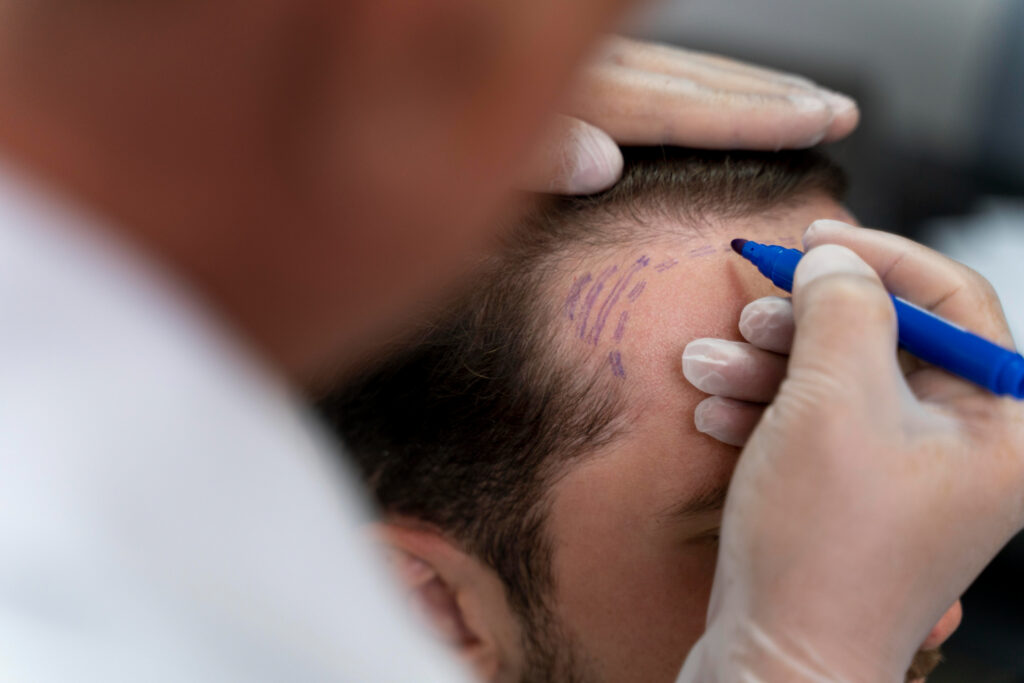
A hair transplant is a surgical procedure. Hair follicles are taken from a part of the scalp — usually the back or sides, where hair is denser — and moved to areas where hair has thinned or stopped growing altogether.
The two most common methods are FUE (follicular unit extraction) and FUT (follicular unit transplantation). Both require local anaesthesia, and recovery can take a few weeks. The results are considered permanent because transplanted follicles come from areas resistant to the hormone that causes most hair loss.
PRP vs hair transplant: the main differences
The most important difference is what each treatment actually does. PRP works by improving the health of existing follicles — the ones that are weak, miniaturised, or producing thin hair. It cannot restore follicles that are completely gone. A hair transplant, on the other hand, physically replaces missing follicles by moving them from one area to another.
PRP is non-surgical, has almost no downtime, and is repeated in sessions over several months. A hair transplant is a one-time procedure (though touch-ups are sometimes needed later), but it involves surgery, recovery time, and a significantly higher cost.
In terms of candidacy, PRP works best when hair loss is still in its early or moderate stages. A hair transplant is generally considered when there is already noticeable baldness or significant patch loss, and enough donor hair is available.
Who is a good candidate for PRP?
PRP tends to work well for people who are in the early stages of hair thinning — where the scalp still has follicles that are alive but not functioning well. Common candidates include those with androgenetic alopecia (the most common type of hair loss in both men and women), people experiencing postpartum hair fall, or those with diffuse thinning across the scalp.
It is also a reasonable option for people who are not ready for surgery, or who want to try a less invasive route first. Some patients use PRP treatment as a way to slow hair loss and delay the need for a transplant in the future.
Who is a better fit for a hair transplant?
A hair transplant makes more sense when hair loss is well advanced — think a receding hairline that has moved significantly, or large areas of the scalp that are completely bald. At this stage, there may not be enough healthy follicles left to respond to PRP, so stimulating the scalp alone cannot bring back what is no longer there.
It is also important that a patient has enough donor hair, stable hair loss, and no underlying medical condition that would increase surgical risk. This is why a proper evaluation by a dermatologist is needed before deciding.
Can PRP and hair transplant work together?
Yes — and this is something many patients do not know. PRP is often used as a supporting treatment before or after a hair transplant. When given before surgery, it can help prepare the scalp and improve follicle health. When given after, it may help transplanted grafts settle better and reduce recovery time.
So rather than thinking of PRP vs hair transplant as an either-or decision, many patients actually benefit from using both — one as the primary procedure, the other as support.
What are the side effects of each?
PRP hair treatment side effects are generally mild. Some patients notice slight soreness at the injection sites, minor scalp redness, or temporary swelling that settles within a day or two. Serious complications are rare when the procedure is done in a proper clinical setting.
Hair transplant side effects tend to be more significant — post-surgical swelling, temporary scabbing, possible infection, and in some cases visible scarring depending on the method used. The recovery period is longer, and the transplanted hair often sheds before regrowing, which can be alarming if you are not expecting it.
Why you should see a dermatologist before deciding
Hair loss does not have one single cause. Androgenetic alopecia, thyroid issues, iron deficiency, alopecia areata, hormonal changes — each of these looks different under examination and responds to different treatments. A dermatologist can identify what is actually happening before recommending any procedure.
If you start PRP without knowing whether your hair loss is active or stable, or without knowing what is causing it, you may not get the results you expect. The same applies to transplants — taking grafts from the wrong donor area, or operating before hair loss has stabilised, can lead to disappointing outcomes.
At Dr. Kshitij Saxena’s Skin Clinic in Lucknow, patients are evaluated for the type, pattern, and stage of hair loss before any treatment plan is made. PRP for hair growth is offered as a medical procedure — not a cosmetic add-on — with proper assessment behind every recommendation.
Frequently asked questions
Is PRP better than a hair transplant?
Neither is universally better — they treat different stages and types of hair loss. PRP works well in early-stage thinning by improving follicle health. A hair transplant is more appropriate when hair loss is advanced and follicles are permanently gone. The right option depends on your specific condition.
How many PRP sessions are needed for hair loss?
Most patients start with three to four sessions spaced about a month apart. After the initial course, maintenance sessions every six to twelve months help sustain the results. The exact number varies based on the severity of hair loss and how well the scalp responds.
Can PRP reverse baldness completely?
PRP cannot reverse complete baldness. It works by reactivating follicles that are still present but underperforming. If a follicle is completely gone, there is nothing left to stimulate. For significant bald patches, a hair transplant consultation would be more appropriate.
Is a hair transplant a permanent solution?
Transplanted hair is considered permanent because the follicles used come from areas that are genetically resistant to DHT — the hormone responsible for most common hair loss. However, hair loss can continue in non-transplanted areas, which is why some patients return for follow-up sessions or combine transplant with PRP.
Can I do PRP after a hair transplant?
Yes. PRP is often recommended after a hair transplant to support graft survival and reduce recovery time. It can also help maintain overall scalp health and reduce ongoing hair loss in surrounding areas. Your dermatologist will advise on the right timing.